
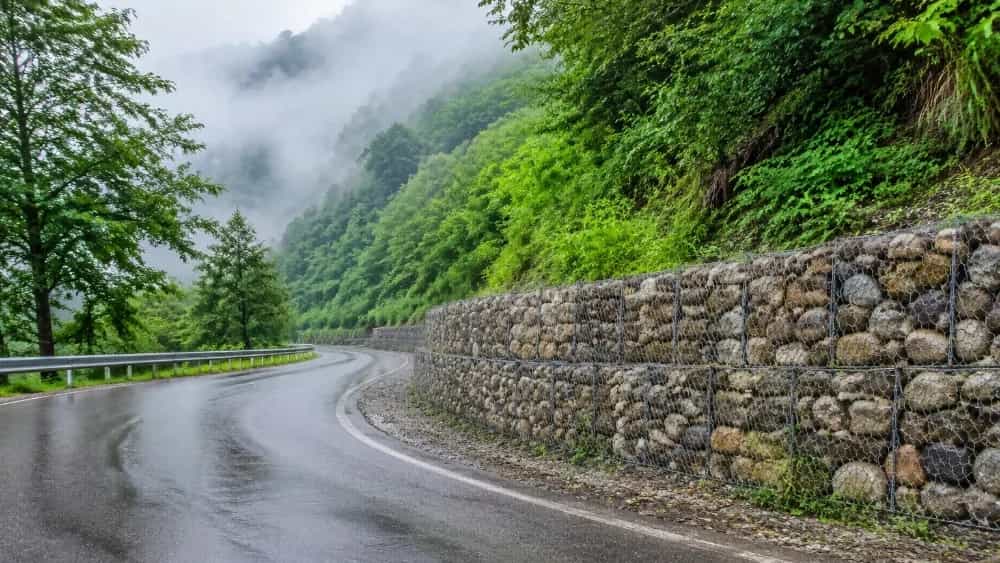
The necessity of implementing gabion in the mountainous axes of Gilan
Implementation of gabions in the mountainous and rural roads of Gilan is a proven engineering solution to curb landslides, stabilize earthen trenches, and prevent rock fall in heavy rainfall areas. Due to the special climatic conditions of Gilan province, permanent soil moisture and heavy rains, rigid concrete structures suffer from cracking and destruction due to the impossibility of drainage and high hydrostatic pressure, while gabion structures show the best performance in these climatic conditions due to their natural permeability and high flexibility. In the executive projects of Salman Maqsoodi's team in the foothills and rural areas of the province, the use of native river gravels along with galvanized nets with standard thickness ensures the long-term stability of the roads.
Climatic and geological challenges of Gilan in road construction
Guilan's rural and mountain roads, such as those leading to the heights of Masuleh, Dillman and Ashkorat, always face challenges such as heavy rains, seasonal landslides and severe soil erosion. In practice, it has been observed that the traditional or concrete retaining walls in these areas, due to the lack of proper drainage and the saturation of the soil behind the wall, after a few seasons of rain, collapse and overturn. Gabions, or net cages filled with stones, do not allow water to accumulate behind the structure due to their porous structure, and the underground water pressure is discharged naturally. In the implementation of these structures by the Salman Maqsoudi group, the type of mesh network and the diameter of the wires are calculated and implemented based on the slope of the trench and the amount of mechanical stress in the area.
Technical and economic advantages of gabion compared to concrete structures
The selection of materials in road construction projects in the northern regions should be based on local availability and the region's climate. River gravels, which are abundantly found in the Gilan river bed, are the best option for filling gabion baskets and greatly reduce transportation costs. On the other hand, the flexibility of the gabon wire mesh allows the structure to move without breaking and maintain its shape in case of slight settlements of the road bed or mild earthquakes. This is despite the fact that rigid concrete structures undergo structural rupture against the smallest settlement of the foundation. High execution speed, no need for heavy concrete pouring equipment in difficult rural roads and complete harmony with the green nature of Gilan are other obvious advantages of this system.
Implementation and standardization steps in Salman Maqsoudi projects
The basic implementation of gabion requires strict adherence to geotechnical engineering parameters. In the first step, the geological bed of the route is visited and after excavating and leveling the foundation, the geotextile layer is spread to prevent the fine particles of the underlying soil from being washed away. Then the gabion baskets, which are made of steel wires with a hot-dip galvanized coating (to withstand the high humidity of Gilan), are placed in place and carefully filled with mineral and river gravel. The arrangement of the stones is done in such a way that the empty space is minimized and placed in the work view of well-shaped stones. Finally, the internal bracing of the baskets with back-up wires and the precise closing of the doors bring the structure to full integrity so that it is resistant to the impact of falling stones and river floods.